
“Insanity: doing the same thing over and over again and expecting different results.”- Albert Einstein, formulator of the Theory of Relativity
If one were to think about the age old adage that politicians “campaign in poetry and govern in prose,” the image of President Obama would not escape you. In 2008, then-Senator Obama’s campaign was well disciplined and ran on all cylinders, no part more so than his oratory on the stump which literally made voters swoon in his presence. Few swoon in response now to President Obama, particularly because the divisive campaign rhetoric that the President employs is a much coarser approach than the politics of unity he championed only four years ago. Though none of the current Republican contenders have Mr. Obama’s oratory skills, they can learn from a fellow Republican – one who, given the country’s dire fiscal situation, conveys the notion that it may be best to actually campaign in prose and leave the poetry at the door. The Republican I speak of is Congressman Paul Ryan (R-WI).
At only forty-two, the Wisconsin representative is perhaps the most mature amongst our elected officials in the nation’s capital; he is certainly one of the most serious. Mr. Ryan chooses to recognize reality, and therefore he is able to acknowledge that there is a problem with a system that functions (for lack of a better word) while operating at an annual deficit of over one trillion dollars per year. Mr. Ryan’s common sense approach to governance uses the statistics and actualities of the real world as evidence to the fiscal death spiral in which our country is caught. Instead of employing empty speeches regarding the debt and making grand overtures to an always elusive remedy, Mr. Ryan has actually created a plan offering real change to confront the policies which have brought the Republic to this point, in what he deems the “the most predictable crisis we’ve ever had in this country.”
On Tuesday this week, Mr. Ryan unveiled the House Republican Budget Plan for the United States Federal Government for 2013. The plan calls for a simpler tax code, breaking our current tax bracket system down from six brackets to just two, at twenty-five and ten percent. It recommends a plan to reform the various problems of Medicare, arguably the biggest weight on the government’s sinking ship of insolvency, by proposing the use of the real market system to temper high costs without cutting the benefits to seniors or shifting the bill onto the shoulders of posterity. The bill cuts discretionary spending throughout the autonomous agencies existing in our federal government which are currently run by faceless bureaucrats that function beyond the reproach of the voting citizenry. These cuts also allow for more serious budget for Defense, which is currently being gutted for $600 Billion over the next ten years as a result of last year’s deficit reduction deal; these are the very cuts that Obama Defense Secretary Leon Panetta, along with other military dignitaries, admitted would have dire effects on the American military. And most importantly, the budget cuts spending by five trillion over the next decade, and though this writer is no financial wizard, these remedies all sound like warranted changes for a country in debt for fifteen trillion dollars.
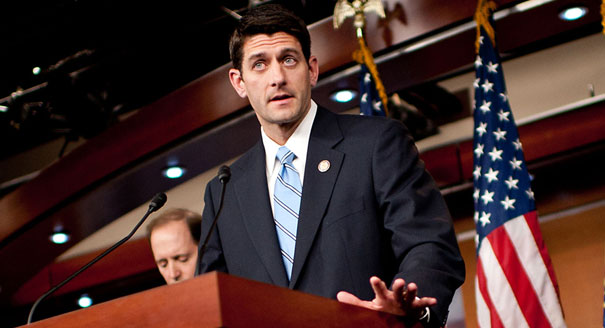
House Budget Committee Chairman Paul Ryan (R-WI) unveils a budget plan Tuesday that actually begins to confront the fiscal problems facing the federal government.
But this is not what Democrats would have you believe. For the party whose leader campaigned on confronting the lavish spending and irresponsibility of Washington D.C, these politicians seem to believe that the campaign poetry does not need to be backed up with the governing prose. Why make the hard decisions to change the policies that have put our country on this fiscal path of self-destruction when you can rehash the same baseless attacks on your opponents who are making an attempt to do so:
From Jay Carney, White House Spokesman: “What we see in this proposal is, again, much like its predecessor, essentially a shift of money from the middle class, seniors and lower-income Americans, disabled Americans, to the wealthiest Americans.”
From a statement released by House Democrats: “a vicious plot to destroy our nation’s promise to our seniors.”
Coincidentally of course, the largest bloc of voters in the United States is seniors, so what better way to win them over than by creating an environment of fear and panic over the bill? Does anyone honestly think Mr. Ryan, a husband and father of three, has the sinister intentions of bankrupting senior citizens, or even worse, denying them the healthcare they need? The most important part of this plan is in fact the Medicare reforms. The public’s current despondence with the federal government is rooted in its failure to come together and confront the problems our country faces. Entitlement reform is the whole ball game, and Democrats are paralyzed with fear to actually confront the problems of these programs in an election year. The Washington Post displays the true colors behind this mindset in the very first sentence of its article describing the Ryan proposal:
“House Republicans laid down a bold but risky election-year marker Tuesday, unveiling a budget proposal that aims to tame the national debt by reshaping Medicare…”
“Bold but risky.” I imagine when facing fifteen trillion dollars in debt, a bold plan to change damaging policies is necessary to deviate from that course. In terms of risk, it is only risky if democrats choose to politicize these remedies rather than attempt to meet Mr. Ryan half way, or God forbid actually move forward with his proposals. It is only risky if Democrats choose to demonize Mr. Ryan by appealing to a nation already stricken with uncertainty with accusations of the Republican’s “vicious plot.” It is only risky if Democrats refuse to acknowledge the reality of our situation in the public conversation, and remain steadfast with the Democratic-utopian view that everything will be fine as long as we tax the rich a little more, and then spend a little more. Proposing actual solutions to save a debt ridden super power should never be considered “risky.” The only risk is to treat the problem as it has always been treated: by acting with ignorance, hubris and ultimately self-destruction.
For Mr. Ryan, this reaction by Democrats came as absolutely no surprise. He is prepared to back up his plan with the cold hard facts and grim reality we face if nothing is done to change our fiscal policies; Medicare reform, decreased discretionary spending and a simpler tax code is just the tip of the ice berg. Anyone who truly believes we can continue to coast along without recognizing the damage already done, and the deluge coming our way, seems much more determined than Mr. Ryan to formulate a vicious attack not only on our seniors but on the future of the United States. There are of course changes that can be made in this resolution to address its weaknesses and oversights- such as the two tax brackets and what will sure be an issue over the “cutoff” point bumping your income tax from 10% to 25%. But considering the challenge in front of us, this certainly seems like a start towards the rebuilding of the United States and strengthening its position in the world.
Despite the coming back and forth over the resolution, which will occur between both parties as well as within each party, it is obvious now that the President’s Hope and Change of 2008 was left at the door by his party and administration once Mr. Obama took the oath in January 2009. The proper prose to back up this poetry was never apparently written. The only change we hear about now is from a Wisconsin congressman, and it is the best chance for hope we’ve got.
– John P. Burns
 tammanyhalldotcom
Pingback: The Importance of a 6-3 Decision | tammanyhalldotcom