Category Archives: Uncategorized

Peace and Prosperity through Strength

“I and others consider the United States ‘the sanctuary’ for the future of the world.  It is a big responsibility for a President, but you should know the world relies on your good judgment and wisdom.” – message from Pope John Paul II to President Ronald Reagan, December 15, 1981.

With Mitt Romney leaving the domestic camping trail for the high seas of international diplomacy last week, an underlying feeling of unease follows in his wake.  Despite what the Obama campaign would have you believe if the Governor were suddenly to disappear from our shores, things did not get better for the American economy.  GDP growth this last quarter was at 1.5%, the lowest it has been in the “Great Recovery” of the Obama presidency.  This number presents little evidence that our economic outlook will be any brighter in November than it is right now, plagued with a continual unemployment rate over 8% and another downturn in consumer activity. 

While this dismal outlook seems par for the course since the financial collapse of 08-09, “adjustments” made in last year’s congressional budget deal to combat our self-imposed fiscal calamity threatens the future of the United States far more than a high unemployment rate.   The guillotine of sequestration that currently hangs over the figurative head of the Defense Department will slash the department’s budget by almost $500 billion over the next ten years, and severely change the way in which the American military will function.  If we fail to elect a responsible executive this November, and even more so a competent congress, then the United States’ ability to lead in an increasingly dangerous world will be diminished beyond recognition – leaving our own shores and those of our allies in danger of threats we cannot deter.

An approach to this problem for Mr. Romney can be found in Martin and Allantine Anderson’s Reagan’s Secret War.  The book describes President Reagan’s acknowledgement of the inherently dangerous affect a weakened U.S. economy has on our ability to lead in the world, and what he did to take that challenge head on.

Upon entering office in 1981, President Reagan was faced with double digit inflation, a diminished military, and an incredibly powerful Soviet Union whose war machine grew stronger every day.  Despite the phony representation of his policies by the liberal media and Carter administration, Reagan was in no way a radical or war monger.  In fact, he felt the urgent need to decrease the number of, and one day eliminate, nuclear weapons between the two superpowers.  But he realized this task could not be achieved if the U.S.S.R. held the advantage militarily, as there would be no need for its leaders to come to the table to negotiate any concession to the United States.  President Reagan knew a military buildup was the only way to even the playing field; to have the ability to strengthen the country’s defense, however, he first had to restore America’s path to prosperity.  To do so, he set in a motion a strong plan to reignite the struggling economy with the free market principles catered to enable its growth. 

If Governor Romney were to formulate an overarching argument of the urgency to enact his own policies to restore America’s promise, the example set by President Reagan early in his first term should serve as a blueprint.  As William Kristol noted months ago, it is incredibly hard to defeat an incumbent president with a micro argument of “small government vs. big government.”  After his trip abroad, Mr. Romney can return to the campaign trail connecting a healthy U.S economy and stabilized government to the fortunes of the free people of the world.

Former Polish President and Solidarity movement leader Lech Walesa meets with Governor Romney on his visit. The Nobel Peace Prize winner endorsed Mr. Romney’s candidacy for President of the United States. (ABC News)

Governor Romney’s trip was far from the “disaster” spun by the Obama administration and the increasingly embarrassing main stream media shucking for the President’s re-election.  In fact his speeches in Israel, and specifically Poland, reminds our citizenry and our allies how close our futures are tied to one another. 

In Israel, he correctly cited the difference of culture between the Israelis and Palestinians as the reason for the disparity in fortune between the two groups of people.  Israel is a country heavily influenced by western culture; it boasts a free government and free market economy, which serves as a stark contrast not only to Palestine, but the Islamist theocracies that occupy the savage Middle East desert.  In Warsaw, he delivered a powerful speech recounting Poland’s position on the front lines of World War II and more importantly the Cold War, when Poland broke free from the Iron Curtain and continues to exist today as a thriving free society.  “In an oppressive world, Poland stands as an example and defender of freedom.”  As he further stated in Warsaw:

After that stay in England, I visited the State of Israel- a friend of your country and mine.  It’s been a trip to three places far apart on the map.  But for an American, you can’t get much closer to the ideals and convictions of my own country.  Our nations belong to the great fellowship of democracies.  We speak the same language of freedom and justice.  We uphold the right of every person to live in peace.”

These two democracies are bordered by oppressive regimes in their part of the world.  It is the responsibility the United States to help ensure their safety, and that of other countries like them. 

In the face of the defense sequester, the next president and congress would be well served to remember the old Latin adage si vi pacem para bellum: if you wish for peace, prepare for war.  Any measures that can be taken to strengthen our military to deter conflict abroad are inconceivable given the current state of our economy and further engrossing federal debt.  If our economy continues to muddle along as it has under President Obama, the revenue of the federal government will be severely limited, while welfare programs are expanded and entitlement programs remain insolvent.  As a result, our military advantage would soon be erased, and render our leadership role in the world ineffective, if not non-existent. 

The people certainly want better job opportunities and smaller government, but restoring such promises in our country serve a much greater purpose.  Our economic engine must again be revived through free market principles so we may lead the free societies of the world, and preserve the cause of human liberty that has defined this nation over the last three centuries.  That should be Mr. Romney’s grand argument for change.  He has less than 100 days to make it.           

– John P. Burns

Leave a comment

Filed under Uncategorized

Charles Krauthammer responds to President Obama as only he can

From Fox News’ Special Report with Bret Baier, originally linked over on The Corner at National Review Online

Leave a comment

Filed under Uncategorized

Summer Shakeup Needed in Romney Campaign

“My fickle friend, the summer wind.” 

With the Supreme Court decision to uphold Obamacare and the passing of the Fourth of July, we have now entered the lethargic political haze of summer.  Like road teams in Major League Baseball drained after a hot July weekend in the Bronx, the American people are equally beaten and weary from the constant deluge of “news” that the Presidential campaign has emitted these last two months.

Governor Romney is the challenger, President Obama the incumbent.  Bus rides have been made.  Hands have been shook, and babies’ foreheads kissed.  The Supreme Court decision gave a much needed jolt to the President, whose approval rating has hovered in the mid-forties the last two years with a seemingly never ending lack of growth in the American economy.  It simultaneously bolstered the hopes of Governor Romney, albeit to a lesser extent, with an uptick in donations and rabble rousing amongst the Republican base.  Barring an extremely embarrassing gaffe or devastating scandal, little looks like it will change in this campaign until Governor Romney selects his running mate.  And given the speculation for the short list in the last month- contenders such as former Governor Tim Pawlenty or Senator Rob Portman- it does not seem Governor Romney intends to “shake up” his campaign with his VP pick as John McCain did a la Sarah Palin.

So now as it lies, the polls still give President Obama a marginal lead nationally, both men in the same position as they were when Mr. Romney received his first significant bump after his nomination.  But the President’s lead is better than it looked a month ago.  Originally, this seemed to bode well for the governor that an incumbent president could possess an easily erasable lead right out of the gate.  But now months later, the lack of progression in Mr. Romney’s numbers is nothing less than troubling for those hoping for a conservative victory in 2012.

He has been on the campaign trail as the Republican nominee for President for two months and yet we have not seen any significant movement in Governor Romney’s polling numbers.  Why?  Numerous conservative heavyweights in the past week have called for a reprisal in campaign strategy.  Charles Krauthammer, George Will, Bill Kristol and the Wall Street Journal editorial board, to name a few, have all spoken out against Mr. Romney’s methodical approach to the campaign.  “It’s still the economy and we’re not stupid,” were the words he spoke in New Hampshire.  He is certainly not stupid, but there is a bigger picture to Mr. Obama’s failures than just bad unemployment numbers.

As recently as Monday, Fox News senior political analyst Brit Hume likened the Romney strategy to a rope a dope campaign- let the economy speak for itself, as the president jabs away and wears out his welcome among voters.  Though it is very damaging to the President that the economy is on the verge of a second recession, Mr. Romney seems to be missing the big picture- a president must lead with ideas.  He cannot just let Mr. Obama flounder amidst bad unemployment numbers.  He needs to present plans for an American revival- tax code reform, healthcare reform (that can actually work), welfare reform, a comprehensive foreign policy strategy, debt reduction and above all, bring this all together in a broad approach that can foster a stable economic environment that will get people back to work.  Just because Mr. Obama has not given the American people suitable plans for these areas, and in many cases when doing so only made the situation worse, does not mean people will just vote for Mr. Romney because he is the new guy in town.  This is the United States of America, there is always a bigger picture.

The people are well aware of the dismal state of the republic, but the President has formulated an effective, though dishonest, campaign strategy.  His unceasing attacks on Mr. Romney, Bain Capital and the “wealthy” has been  a successful tactic in engaging his base while simultaneously playing on the fears of the distraught souls trapped in the doldrums of economic stagnation.  He tells the citizenry that these are the people to blame for their problems- the ever elusive “wealthy” in which Mitt Romney, Republican candidate for president, is leader of the club.  The President travels the country to paint their affluence as a product of avarice at the expense of the average Joe- an effort to distort the facts to make the voters “understand” what the real problem plaguing the country is, and it is not the President.

As of Monday, President Obama has recently doubled down on his pledge to raise taxes on those making over $250,000.00 a year.  I know families, as does Democratic Senator Chuck Schumer, who earn incomes over $250,000.00 a year.  It is mind numbing to figure out how increasing the taxes of these good people-living in New York with families, mortgages, college expenses and already high property taxes- will somehow magically jumpstart the engine of the American economy.  Perhaps Mr. Obama knows something we don’t, or perhaps he is just looking for a scapegoat to blame for his own failings.  Either way, Mr. Romney should engage him in the public discourse on more than just “the economy”, before his rope-a-dope strategy puts his chances to win the presidency into a deep summer slumber.

– John P. Burns

Leave a comment

Filed under Uncategorized

The Declaration of Independence: Its Inception, and our Responsibility to Honor its Principles

“We hold these truths to be self-evident, that all men are created equal, that they are endowed by their Creator with certain unalienable Rights, that among these are Life, Liberty and the pursuit of Happiness.–That to secure these rights, Governments are instituted among Men, deriving their just powers from the consent of the governed, –That whenever any Form of Government becomes destructive of these ends, it is the Right of the People to alter or to abolish it, and to institute new Government, laying its foundation on such principles and organizing its powers in such form, as to them shall seem most likely to effect their Safety and Happiness.”- The Declaration of Independence, in Congress July 4th, 1776.

In my previous essay, I wrote about civil discourse in American politics and how it essentially has never been very civil, as opposed to what others would lead the American public to believe.  That subject led me to reference the American victory at Yorktown as a high water mark in American political unity.  Five years prior to that victory though, the American public was sharply divided, perhaps for the first time, in a debate over the monumental decision to rebel against the most powerful empire in the world.  In that public debate, when weighing out the pros and cons of going to war with the British Empire, the logistics tipped heavily in the wrong direction.

Those in the thirteen American colonies that were hesitant to break off from King George III’s rule had a right to act as such.  The American armies were outnumbered, facing far superior forces in training, equipment, and battle experience.  England’s land and naval power were unrivaled by any other country in the world.  Hessian mercenaries were employed by the British to wreak cruel havoc on the shores of the Americans- a specific choice made by the King as a response to punish the particular insult of his ungrateful subjects’ treason.  After the battles of Lexington and Concord, the argument for the “Cause” needed to be made to the people, in particular their reluctant legislatures and representatives in Congress, that the separation was not only necessary, but honorable and just.  To achieve this task, the revolutionaries we have endearingly labeled the Founding Fathers would produce a document that not only successfully made this argument to the people as well as countries abroad, but would accomplish nothing short of changing the world.

From the outset, the intention of the Declaration of Independence was never to change the world in the radical and ultimately transformative ways in which it did.  Quite simply, it was a document to be drafted by a congressional committee- made up of John Adams (MA), Benjamin Franklin (PA), Thomas Jefferson (VA), Robert Livingston (NY) and Roger Sherman (CT) – to make the case to the people and the world abroad that the people’s rebellion in North America was in fact justified and legal.  As Jefferson explained a year before his death in a letter to Henry Lee in 1825:

The draft was “not to find out new principles, or new arguments never before thought of… but to place before mankind the common sense of the subject, in terms so plain and firm as to command their assent…”

It was thought of as a legal document, primarily drafted by the lawyer Jefferson, with an appeal to “common sense” and reason.  As Thomas Paine stated in his own appeal to Common Sense a year earlier, an island nation (Great Britain) should not have the right to govern a continent of millions three thousand miles away.  As crimes against the American people went unpunished by the Crown leading to shots firedand blood drawn on both sides, Washington’s success in the Battle of Boston gave the founders the argument that the time for separation was imminent.

As depicted in a painting by John Trumbull, the presentation of the Declaration of Independence in Congress, 1776.

The Declaration was a success as measured by the intentions explained by Jefferson above, as the people of the country united and were aided greatly in their cause by the French, but there was more to this draft than a simple legal argument for the separation.  Somehow in human history, the words “all men are created equal” were never once put to paper before 1776.  The concept of a government that served in the interest of the people, through free elections, was something almost never considered amongst the kings, Caesars and emperors that ruled in the thousands of years that proceeded this moment.  With John Adams vociferously leading the debate for ratification of the Independence proposal on the floor, invoking the young Jefferson’s awe enough to name the stout New Englander the “Colossus” of Independence, Jefferson’s draft presented an argument that would change the way humanity viewed all forms of government from that point forward.  The five years of war that followed the Declaration would be the first in a long line of morally righteous campaigns in which Americans would sacrifice their lives for the cause of human liberty.

When discussing the Declaration and the country’s founding, it is impossible not to acknowledge the glaring hypocrisy in the document’s words with the existing practice of slavery at the time.  There is really no answer to this charge save for one- the Founders, as immortal as they seem to be in the eyes of posterity, were nothing more than men.  They were tasked with starting a country founded in human liberty, but at the same time the antithesis of that liberty was embodied by the souls shackled in chains in their own backyards.  But what were they to do?  Slavery was only abolished from the country after four years of civil war that resulted in the deaths of over six hundred thousand Americans.  The Founders were tasked with creating the United States first and foremost, and although having to do so with the existence of slavery was unwelcome, the alternative became an impossible position to negotiate when it was already a struggle to convince the citizenry to rebel.  In the Declaration, Jefferson charges the King with the crime of this cruel practice, but at the beshest of Congress and specifically the southern colonies, the passage was removed.

“He has waged cruel war against human nature itself, violating its most sacred rights of life and liberty in the persons of a distant people who never offended him, captivating & carrying them into slavery in another hemisphere or to incur miserable death in their transportation thither….  Determined to keep open a market where Men should be bought & sold, he has prostituted his negative for suppressing every legislative attempt to prohibit or restrain this execrable commerce.  And that this assemblage of horrors might want no fact of distinguished die, he is now exciting those very people to rise in arms among us, and to purchase that liberty of which he has deprived them, by murdering the people on whom he has obtruded them: thus paying off former crimes committed again the Liberties of one people, with crimes which he urges them to commit against the lives of another”.

Though this was used as a charge against a tyrannical king, it was evident the slaveholder Jefferson did believe in the inhumanity of the practice.  The Founders took such steps to help eradicate slavery, albeit slowly, through acts such as the Northwest Ordinance of 1787, prohibiting slavery in territories north and west of the Ohio River.  In the Constitution, the provision was passed that laws restricting the slave trade could be passed as of January 1, 1808- again leaving the door open for action to be taken against the heinous institution.   As a point made countless times in Senate and Presidential campaigns of Abraham Lincoln, the Founders put in place a pragmatic process to ultimately rid the United States of its original sin.  That they were tasked with founding and keeping the country intact through stability provided by the rule of law only proves that they were men limited by circumstance and reality- a combination in which prevented them from abolishing slavery outright.  The burden would have to fall on the shoulders of posterity to right this immense wrong in our nation’s history.

The responsibility of the United States of America continually rests on today’s Americans and their children.   The day the Declaration was signed by John Hancock marked the beginning of what became known as the “American Experiment”- an endeavor in which the government was to be constructed as an instrument to serve the people.  As noted by Benjamin Franklin after the constitutional convention, when answering the question of what kind of government would be formed, he responded “a Republic, if you can keep it.”  Dr. Franklin’s words are as important today as they were in 1787.   Our citizenry continually faces the challenges and temptations to veer from the virtuous path of self-government and personal responsibility.  The alternative, placing their faith in the form of an all-powerful governing Leviathan, would not only cripple the individualism of the public but completely rebut the principles of the Declaration of Independence.  At the Republican national convention in 1964, Ronald Reagan echoed this sentiment in his speech, A Time for Choosing:

“If we lose freedom here, there is no place to escape to. This is the last stand on Earth. And this idea that government is beholden to the people, that it has no other source of power except to sovereign people, is still the newest and most unique idea in all the long history of man’s relation to man. This is the issue of this election. Whether we believe in our capacity for self-government or whether we abandon the American Revolution and confess that a little intellectual elite in a far-distant capital can plan our lives for us better than we can plan them ourselves.”

President Reagan, sixteen years before he served in the oval office, understood that this is our constant dilemma in twentieth, and now twenty-first century America.  The world was changed the day the Declaration was ratified, and it is our obligation as Americans to honor and adhere to the words written by Jefferson and championed by Adams, in continuance of the American Experiment.  This burden that befalls all Americans is renewed in the collective soul of the country on every July 4th, with the fantastic celebrations serving as a reminder of our solemn duties.  The celebration of the Fourth of July today fulfills Adams’ prophecy that that day in history would be “celebrated, by succeeding Generations, as the great anniversary Festival. It ought to be commemorated, as the Day of Deliverance by solemn Acts of Devotion to God Almighty. It ought to be solemnized with Pomp and Parade, with Shews, Games, Sports, Guns, Bells, Bonfires and Illuminations from one End of this Continent to the other from this Time forward forever more.”

The United States is, and possibly forever will be, “the last best hope on earth.”  This hope endures that someday, it can be recognized by all world leaders that the seat of power must rest in the voice of the people, championing the principles of liberty and not tyranny, individualism and not socialism, equality and not oppression.  On the 236th anniversary of our independence, let the citizens of the United States renew their vow to uphold these ideals, and again as in 1776, pledge to each other our lives, our fortunes, and our sacred honor.

– John P. Burns

Leave a comment

Filed under Uncategorized

The Founding Fathers and the Politics of Today: Part I

Civility in Public Discourse

This weekend, Aaron Sorkin and HBO’s new television show Newsroom premiered with much anticipation from the viewing public, thirsty for relief after their recent loss of Game of Thrones.  Sorkin, the Emmy and Academy award winning writer who has brought us stand out work such as A Few Good Men, The Social Network and The West Wing, made his cable debut in the network drama.  In each review I’ve read, the subject of civil discourse was mentioned as a dominant theme.  

After watching it Sunday, it is evident that “civil discourse” and Mr. Sorkin’s contempt for its current state today in both politics and political reporting is a strong theme in the new show.  This is not a novel idea in which Sorkin will reshape the world of politics.  The President also laments over the current lack of civility in our political arena, as well as other Democrats, Republicans, Socialists, Neo-Nazis, Mets fans, and Heat fans to name a few.  Whenever I hear this from either side of the aisle I find it hard not to laugh.  Besides the fact that this false indignation is nothing more than a political ploy, one usually utilized by the side sitting in power who takes the daily brunt of ridicule from the opposition, those who use it also pine for the politics of yesteryear as if there is some magic example from America’s past to save us.  Even the original description for this space when it was created read: to advance the political discourse of the United States.  Really Mr. Burns, how about we solve the debt crisis first?

An uncivil discourse is the price one pays for the good fortune of living in a Democratic-Republic, where the peaceful transition of power is one of the, if not the highest priority in the United States.  Our civilized society functions absent the use of violence as a means to political ends.  That being the case, the road to political power in the United States is through oratory and the written word, and these words are often vitriolic.  Short of going after one’s family members (unless of course it is a member of the Palin family), anything and everything is deemed fair game. 

The last day Americans were actually unified politically was the surrender of the British at Yorktown.  Since then, whether it be Federalists and Anti-Federalists, Democratic-Republicans and Whigs, or Republicans and Democrats, the divide in this nation has been far and wide between ideological nemeses of both parties, and also at times within the parties themselves.  In 1789 General George Washington was the most revered man in America, and the only President ever elected unanimously by the Electoral College.  Yet half way through his first term, a significant number of men with whom he built the federal government turned their backs on his policies as President.  The influence of Treasury Secretary Alexander Hamilton became too prevalent in the President’s decisions, his opponents said, and for the first time in twenty years the great hero of the revolution felt the backlash of negative public opinion. 

The National Gazette was published by an opposition party on October 31, 1791 (Madison and Jefferson, Burstein and Isenberg, Random House 2010) by a Frenchman named Phillip Freneau, but at the secret behest of more powerful figures.  At this point political parties had not been officially established, but arguments and attacks of President Washington’s policies and that of his advisors were presented with the coordination and passion we see today by current politicians, partisan pundits, and news organizations.

The puppet master behind the curtain of this new editorial paper was none other than a member of the Washington’s cabinet, Secretary of State Thomas Jefferson, as well as Virginia Congressman James Madison.  Both men at one time revered Washington as much as any man in America, probably more so given the struggles they understood he endured in the execution of the Revolutionary War, and the new weight he carried as President of the young nation.  All three were “men of Virginia”; farmers who helped deliver the birth of a new nation that now stood alone in the world, and together they were tasked with its keeping.  Madison was Washington’s chief advisor throughout the Constitutional convention, and later became Washington’s principle speech writer in the early days of his presidency.  Jefferson served as a member of the Second Continental Congress that named Washington General of the Continental Army, and after returning from France in 1789, was named by Washington to serve as his Secretary of State- the country’s first official diplomat to the world at large.  

Yet within two years into his first term as President, both men became vehemently opposed to Washington’s policies to help centralize the federal government, which both men suspected was a direction taken by the president influenced heavily by Washington’s now most trusted advisor, Alexander Hamilton.  Jefferson soon resigned the position of Secretary of State, sparking a decade long struggle for power between the Federalists (Washington, Hamilton and Adams) and the Jeffersonian-Republicans (Jefferson, Madison, Monroe).  The battle was furnished with published pamphlets oozing of libel, backdoor dealings and maneuvers to undermine the opposition, and a general distrust between old friends.  This culminated in an all-out battle for the soul of the nation that ended when Jefferson assumed the Presidency, and all but politically wiped out the remaining “Federalists” of the time period. 

As such, our Constitution’s rule requires the candidate win 50% plus one of the vote in the Electoral College to attain the Presidency, the highest office in the land.  This resulted in the production of two parties, gearing our elected officials in opposition or support of the sitting President, molding their party principles based on the current circumstances of the country based on economics, foreign policy et al.  The institution of the United States government is no stranger to opposition within the government, usually vied between different branches.  This stark example of Jefferson walking out on Washington, or serving in fierce opposition as Vice President to his former ally and friend President John Adams, are just a few of countless examples in which civility has been entirely absent in our American political system.  

The good feeling of the victory against the British could not save these men from the dinge of politics, an arena that became so coarse that the President’s senior cabinet advisor resigned before he could barely begin his second term as president.  In that term, Jefferson used the veil of retirement to allow him to secretly plot against President Washington, his emerging party and its agenda.  There could not be a better illustration depicting the struggles of civility between parties in American politics in the country’s history save for a tragic and monumental example in 1861.  This tale which is one of hatred, jealousy, lust for power, and ultimately betrayal, occurred between a collection of men who took on so monumental a task together as founding a new nation in a New World.  Just because of their iconic status as Founders- Washington a great leader, Jefferson a great writer, or Adams a great orator- doesn’t lift the taint of their parties’ mutual dissatisfaction for the other, and the means they employed to discredit the opposition.  What binding achievement such as the founding will keep our civility intact in our own times? 

The current trumped up charge that civility in politics is a relic that existed during better times in our country is one advanced by both sides of the aisle.  This tact allows each party to claim ownership to the positions that will only help our country and right the failing policies of our federal government, simultaneously making the charge that the opposition only stands in the way with their uninformed rhetoric.  This ignorant and libelous rhetoric, somehow always employed by the “other side”, only demonizes their opponents without offering real solutions to advance progress in this country.  This hackneyed allegation has become, like so many other things, just another political parlor trick in the war of words that dates back more than two centuries in the United States. 

Americans are inherently suspicious of power in the hands of our elected officials that we actually chose to vote for.  We are even more suspicious of those we did not choose support and we make a point of saying so, often vociferously and sometimes viciously.  It may not be neat, nor is it civil.  But it never has been.  And never will be. 

– John P. Burns

Leave a comment

Filed under Uncategorized

No Change to the Way Washington Works

“No one in government takes responsibility for anything anymore. We foster, we obfuscate, we rationalize. ‘Everybody does it,’ that’s what we say. So we’ve come to occupy a moral safe house, where everyone’s to blame, so no one’s guilty”- Aaron Sorkin, The West Wing

Like many presidential candidates before him, Senator Barack Obama ran in 2008 as the reform candidate.  He ran as the Washingtonoutsider – a fresh and bold voice in an antiquated city of corruption and graft.  He ran as the man that would vanquish the partisanship of the Bush years from our nation’s capital.  He ran as the man who would simplify government, and turn it into a well- oiled machine.  He claimed he would go line by line to fix our budget, halve the debt in his first four years, and cleanse the disarrayed leviathan of bureaucracy and inefficiency.  He claimed lobbyists would not be allowed in his White House.  And above all, he would restore our citizen’s trust in our government, and put their lives on a path back to prosperity. 

All of this was enticing, refreshing and above all, a great sell.  But now, three and a half years later, none of what has been mentioned above has been accomplished, and Republicans have made that argument at every turn of the campaign.  And though they do not expect Mr. Obama to roll over, he and his supporters’ new plan of attack has taken political hypocrisy to new levels- a phenomenon that, before 2009, no one thought could possibly happen.

At a fundraiser this past Tuesday (he’s quickly approaching 200 for his first term), the president argued the allegations made against him about his fiscal mismanagement are not only hypocritical, but of complete falsehood:

“I love listening these guys give us lectures about debt and deficits…it’s like somebody goes to the restaurant, orders a big steak dinner, martini, all that stuff and then just as you’re sitting down, they leave and accuse you of running up the tab.  That’s what they do.”

The problem with the quote above is not that President Bush ran up the debt and deficit spending (he did), but somehow the American people shouldn’t expect the President to put forth measures to fix it.  Nor should they expect him to actually stop the practice, which has helped cripple our economic growth.  Essentially, like a seven year old caught with his hand in the cookie jar after his friend had already plundered his own, Mr. Obama feels he can do just as Mr. Bush did, and then blame it on him. 

Image

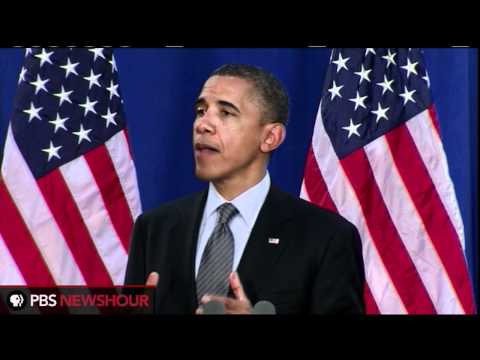
At a fundraiser Tuesday, the President continues to direct blame for our poor economy as opposed to proposing remedies to encourage growth.(PBS Newshour)

Mr. Obama inherited four trillion dollars in new debt from Mr. Bush over eight years, including President Bush’s’ final fiscal year (counting bank bailouts and TARP) which included one trillion dollars of debt on its own.  But just because President Obama was handed a tough situation (he was) means he automatically gets eight years to fix it?  Instead of making the tough decisions of actually attacking our government’s inefficiencies (out of control spending, overloaded welfare and entitlement programs) the president decided to follow in Mr. Bush’s footsteps and then hop right over him. 

Mr. Obama has accrued annual deficits of one trillion in not one year as Mr. Bush did, but in every year of his first term, running up more debt in that one term than any other President has in two.  The people of the United States understand Mr. Bush made mistakes- namely handing over the keys to the Treasury vault to the Republican congress presiding in the years 2000-2006.  President  Bush paid for those mistakes when said Republicans were thrown out in that 2006 election, paving the way for the Pelosi Democrats to take control of the legislature.  But those Democrats spent just as much, and when Mr. Obama was sworn in he soon followed suit.  At this point it can be argued, and should be argued as advocated by Peggy Noonan and Jonah Goldberg, that President Obama’s first term is an extension of President Bush’s.  Not only has he continued President Bush’s policies of containing terrorism (a good thing) but continued his fiscal actions of irresponsibility (a very bad thing).

To bring this full circle, as it comes back to campaigning for every politician, the message put forth in this speech by the president is essentially that because Mr. Romney is a Republican he will continue the “failed polices” of the Bush years.  And, all things being equal, because the country voted for Mr. Obama as a repudiation of Mr. Bush, he should be returned to office to prevent a third term for our beleaguered former President.   If that were the case though, and President Obama’s policies were such a stark contrast to Mr. Bush’s and above reproach, Democrats wouldn’t have been wiped out of the House in 2010 in historic fashion.  And, as the incumbent president, Mr. Obama would not be polling only 0.8% higher than Mr. Romney in the RCP average for national polls. 

Republicans lost their way in the previous decade.  Mr. Obama made a point to inform the nation of that in 2008, but two years later the likes of Paul Ryan, Mitch Daniels, Bobby Jindal, Chris Christie, Marco Rubio and Mitt Romney have agreed with him.  There are new leaders of the Republican Party who are promoting new policies (albeit founded in the old American principles of personal responsibility) that directly combat the fiscal problems of the Bush years, whose results have now been prolonged by Mr. Obama.

President Obama has had a tough start to his re-election campaign.  Most recently he made the claim (or gaffe) that the private sector “is doing fine,” as dismal job numbers were reported that created a stomach punch reaction in the stock market.  So now he has reverted to the old adage of blaming President Bush for our woes, and the republicans who, if returned to the White House, will bring us back to those evils.  But those problems haven’t ended under the President; they have been exacerbated by his own initiatives and that of his party at a frightening pace.  President Obama should perhaps think twice about making the constant references to President Bush, as he only continues to draw comparisons to his own actions in his first term, and their failures.  

– John P. Burns

Leave a comment

Filed under Uncategorized

Walker Win in Wisconsin Restores Hope in Self-Government

“By a faction, I understand a number of citizens, whether amounting to a majority or a minority of the whole, who are united and actuated by some common impulse of passion, or of interest, adversed to the rights of other citizens, or to the permanent and aggregate interests of the community.”- James Madison, The Federalist No.10

There is still hope for theUnited States, and for that matter the entire European Union, in the results ofWisconsin’s recall election this Tuesday.  The voters of Wisconsin returned Governor Scott Walker to office after a nasty recall vote, which was an appeal for his head as much as his office by the well-organized and aggressive public sector unions.

After Mr. Walker was elected in 2010, he began to make good on his promises to bring down the state debt and alleviate its burden on Wisconsin citizens.   Mr. Walker chose to challenge the state’s public sector unions, and enacted plans which he campaigned for in order to force them to pay more into their health care and pension plans, as well as diminish the power of their collective bargaining agreement.  These measures were created to lighten the load on the tax payers (property taxes have dropped in the last year) and enableWisconsinto avoid the fiscal catastrophe that awaits many other states in our Republic as a result of bloated benefit plans for state employees.  These unions rallied and gathered all their political strength through the Democratic Party to recall the governor‘s election, running Mayor of Minneapolis Tom Barrett against him.  In turning back the democrats’ efforts for the governor’s office, the voters ofWisconsinTuesday proved a government of the people, by the people and for the people, can still make tough choices when faced with challenges to which there are no easy remedies.

And to be clear, these choices should not be as tough as they are reported to be, especially in the mainstream liberal media.  All the respect in the world should be given to people who choose a life of public service, working in state and federal government positions to keep our water running and help manage the important role government does play in our lives.  At the same time, this does not give such groups carte blanche in their benefit demands.

As recently as the Carter administration, Democrats had avoided supporting government unions and collective bargaining agreements, as the pitfalls of such organizations were easy to predict.  Their unionization has helped paint state and local governments into corners, allowing for lavish benefit plans that cripple their state budgets.

When the Democratic Party lost its way giving strong support to these unions, the labor bosses were given unprecedented powers of demand in their respective states.  All state employees were forced to blindly pay dues into their respective unions, dues which have dropped since such unionization has been repealed in places like Wisconsinand Indiana.  Money was then funneled through these unions’ dowries where the fat cats at the top of the power structure chose to use this money to strongly support politicians that would continue to extend their benefits, essentially buying their elections.  This has continued to spiral out of control in the last thirsty years, leaving state governments in the impossible position of paying for these benefits less the levying of higher taxes on the citizens of their state.  This goes against the grain of logic, as such measures leaves less money for the very public these public servants are meant to serve.

With Mr. Walker, as well as Indiana Governor Mitch Daniels, strong reform was pushed to revamp these plans.  Mr. Walker and Mr. Daniels stilled aimed to prove worthy benefits for state employees, but forced  them to pay more.  As reported by George Will, under Mr. Walker’s plan state employees were asked to contribute 5.8% (most were paying less than 1%) to their pensions and pay 12.6% of their healthcare premiums.  This is far less than the private sector average on both, as most work today without pension plans and pay on average 21% of their healthcare premiums.  While it is understood strong benefits are created to entice people to work in public service, essentially making up for their low salaries, these benefits cannot become so extravagant they become a financial anchor on the state economy and the people.

What do the results of this recall election say?  A lot.  The historic danger of a Democratic-Republic as argued since the days of Romehas been the interests of factions dominating the government, constantly voting themselves more money and more benefits at the expense of others.  It was the fear of Madison in The Federalist, as well as Lincoln seventy years later, that our republic would not survive under the weight of this burden, and would be torn asunder from within.

We see now in the United States, as well asEurope, that entitlement benefits have spiraled out of control, and have placed a heavy toll on the fiscal solvency of state and federal governments.  The result of this recall election. which as gave Mr. Walker an even larger margin of victory than in his 2010 election, does give hope that citizens can act responsibility when their future is at stake.  Reforms that have seemed to work in the last two years can now be continued, and the people ofWisconsin, as well as the country, will see if there is a way we can dig ourselves out of this massive hole.

Lastly, this will affect the Presidential election as well.  Governor Romney will surely take notice and push the successes of Republican governors Walker and Daniels in their states’ respective fiscal reforms.  But what about the President?  Mr. Obama has a chance here to do two things- continue the Democrat Party line of blind allegiance to public sector unions, trying again to garner the vote of dependency that has just been rejected in a state he won by fourteen points in 2008.  Or he can take his party on a new path, joining Republicans in the fight to restore our country’s fiscal sanity, as well as revamping the Democratic image.  Reforms need to be put into place, and our public servants still need benefits.  This is a fine line to toe, and it is certainly a challenge considering the heavy hand of power yielded by public sector unions.

But nowhere did anyone say self-government is easy.  It’s just that the voters of Wisconsin, and Governor Scott Walker, are up to the challenge.

– John P. Burns

Leave a comment

Filed under Uncategorized

The New Nanny State: Where does it End Mr. Mayor?

As the federal government continues to grow more intrusive on the lives of the American citizenry, this disturbing trend has taken hold at the state and city level as well, specifically in the city of New York.

Mayor Michael Bloomberg, the elected mayor and knighted Nanny of the city, has continued his crusade against personal choice and responsibility throughout his third term with ridiculous laws like the banning of smoking in parks.  Recently, he has floated the idea of allowing apartment buildings to ban smoking altogether, coming close to nearly outlawing the habit.  Today, as reported by the New York Times, the man without a doctor’s license took his healthy living fight a step further, arguing for a law to limit the size of drinks with sugar (soda, slurpees, coffee ect.) no more than 16oz. 

 The good Mayor’s reasoning, much like the rationalization of almost any constricting health initiative lately in the U.S., is the high obesity rate in the country.   To cut down on this obesity problem, drinks can then be regulated by the amount served to limit the sugar intake of our citizens, helping prevent this disease and the vast complications that arise at its contraction. 

I am no doctor, and quite frankly at twenty-six, one’s health is obviously lower on the radar screen of importance than it should be.  At the same time, if I choose to have a soda, and a large one at that, then it should not be up to the city of New York if I can or not.  I know, as all adults should, that having even one Pepsi (my all-time favorite drink) a day on average is bad for you.  I drink water and club soda with most meals.  The occasional Pepsi gets broken out if I am snacking or just in the mood.  But when I am in such a mood, I do not need the Mayor of New York City telling me I can’t have one over a certain size.  No one I know drinks water in the movie theater, and if one wanted to cut down on the ridiculous pricing of seeing a movie presently, it would be easier to split a large soda with his date than opt for two mediums.  But under this law, he cannot do that. 

If preventing illness by such measures is then acceptable, the Mayor should regulate the butter allowed on popcorn at the movies as well, to help prevent the possibility of heart disease from high cholesterol.  Or maybe ban beer from Yankee Stadium to prevent the side effects of alcohol.  At that point let’s get rid of Hot Dogs at the ball game too for whatever they do to you.  Maybe ban ketchup- there’s a decent amount of sugar there.  Only water and buns sold with mustard are allowed at Yankee Stadium now boys and girls, start spreadin’ the news. 

As always with progressive policies, the one’s created to “protect” the people from themselves inherently limit their freedoms.  Choice is no longer an option under such laws, and the Nanny state grows omnipresent as each new law is passed, making those of us with a head on our shoulders question as to how far the government can go.  If all of this is in the interest of health, and that is how it is spun by our government overlords, then logically it follows that there is no way to judge where this crusade will stop.  Thankfully though, The New York Times covered this story, and provided the public with this rationalization for these measures:

“The measures have led to the occasional derision of the Mayor as Nanny Bloomberg, by those who view the restrictions as infringements on personal freedom.  But many of the measures adopted in New York have become models for other cities, including restrictions on smoking and trans fats, as well as the use of graphic advertising to combat smoking and soda consumption…”

Unsurprisingly, the NYT can be relied on to let the reader know that the government is always right, naturally because the people in office are smarter than you and I.  The proof, much to the chagrin of the few of us who “occasionally” deride the mayor as a Nanny, is that other old rich white men governing cities around the country have taken these measures as well!  Given the current state of the nation, it is comforting to know that we can rely on our mayors and councilmen to take time out of their busy schedules of passing on an all-encompassing debt on to our children and grandchildren, to pass legislation that won’t allow them to drink a large soda at a movie that they probably can’t afford to see in the first place. 

If the mayor is so interested in dictating the minutest details in the lives of his subjects, as we seem to be nothing but subjects at this point, then he should just switch over to the Democratic Party.  This will kill two birds with one stone, as it will rightly fit the ridiculous nanny state policies he has enacted as mayor, as well as ensure him re-election in Manhattan without having to spend half a billion dollars in the process.


– John P. Burns

Leave a comment

Filed under Uncategorized

Take a Moment of Reflection this Memorial Day Weekend

“I feel how weak and fruitless must be any word of mine which should attempt to beguile you from the grief of a loss so overwhelming. But I cannot refrain from tendering you the consolation that may be found in the thanks of the Republic they died to save. I pray that our Heavenly Father may assuage the anguish of your bereavement, and leave you only the cherished memory of the loved and lost, and the solemn pride that must be yours to have laid so costly a sacrifice upon the altar of freedom.”- Letter to Mrs. Bixby, mother of two brothers killed fighting in the Civil War.  From President Abraham Lincoln: November 21, 1864

Amidst the beer, beach and barbeque this weekend, we should all take a moment to reflect on why we celebrate Memorial Day.  For all the platitudes rattled off in election speeches this year about the United States, none can be truer from either side of the aisle than those praising our citizens in uniform.  Now as much as ever- considering our armed forces are made up entirely of voluntary troops- we owe our soldiers the respect and gratitude for their choice to serve in the United States military, vowing to protect the country, the people and the Constitution with their lives. 

Memorial Day was conceived in May 1868 by General John Logan, National Commander of the Grand Army of the Republic.  It was included in his General Order No. 11, and carried out by the laying of flowers on the graves of Union and Confederate soldiers.  Though it was not recognized by the South until after World War I, it is important to distinguish that General Logan chose to honor the dead of the Union and Confederate armies- celebrating those who gave their lives in both sides of that tragic conflict, regardless of allegiance and purpose. 

The holiday was officially federalized in 1971 by Congress, but was long celebrated by the states from World War I onward.  The people, even before their government, understood the importance of memorializing the men killed in defense of the United States in every war since the Revolution.  Our collective understanding and appreciation is the solemn pride embedded in the spirit of this national holiday. 

Our heroes have been laid to rest on battlefields all over the world. Pictured here, the final resting place of 400,000 at Arlington National Cemetery in Virginia.

The importance of the traditional mission of the United States’ servicemen over the course of our existence as a nation could not be overstated, nor can its meaning be fully explained by a writer who has not served a day in uniform.  America is more than just a country made up of land, people and borders. The United States is an idea.  It is the unfinished fulfillment of an idea like no other in human history, where the government presides with the consent of the people.  Its purpose: to foster an environment for the growth and prosperity of the individual, where the rights and freedom of the citizen reign supreme at the center of our founding values.  Our equality in existence is stated in our Declaration of Independence- the first time in human history such words were ever put to paper.

Because of this dedication to liberty our people are not subjects to a despot sitting on an iron throne.  We are not serfs living off the land of some feudal lord.  And we are not slaves to any man or women.  None of this would be possible without the might and right ingrained in the duty of our armed forces- from the Minutemen at Concord and Lexington all the way through Army Rangers fighting today in Afghanistan.  Memorial Day is celebrated to remember those heroes who have served and died to defend the American Idea, wherever and whenever they are asked to. 

Today, the courage on display by solider of the United States is something incomprehensible by the average citizen.  Our fighting men and women are made up of a special breed of people: people willing to venture half way around the world to fight a faceless enemy who cowers in the bush as hidden bombs are triggered on the side of the road; a faceless enemy who sends women into crowds with bombs strapped to their chests; a faceless enemy who targets innocents in the name of their god, a deity so cruel and intolerant that the mind of a rational human being could never conceive of, nor faithfully worship.  Our troops seek out these demons to end their reign of terror in that part of the world, sacrificing their lives as active citizens in the United States, and possibly their lives on earth, to assure those of us at home are protected. 

Whatever the results will be for the 2012 election and elections thirty years from now, the American experiment will endure.  Unfortunately, our reality is a world in which there will be wars that have to be fought by Americans, and some of our countrymen will not return from the fighting.  Let us remember these heroes who have given their life over the last three centuries with not only three day weekend in May, but honor their costly sacrifice every day by preserving the idea of the United States for which they fought.  To do so, Americans must dedicate our lives toward the advancement of a moral, just and peaceful Republic- each one of us living a life worthy of the soldier who selflessly gave his to protect it. 

– John P. Burns

Leave a comment

Filed under Uncategorized

Ebb & Flow of Election Currently has Romney on the Rise

“Never make predictions, especially about the future.”- manager Casey Stengel, seven-time World Series champion with the New York Yankees

Earlier this winter, Charles Krauthammer remarked that the extended primary process enacted by Republicans for 2012 was hurting the party.  In a knee jerk reaction to the quick McCain coronation in 2008, the rules governing the primary contests changed to ensure a longer fight which would allow voters to get an extended look at the entire field.  But, in a year in which the incumbent is being challenged, it is detrimental to keep the focus off the President for an extended period of time.  Given the state of the country under Mr. Obama’s presidency the last three and a half years, it was especially disadvantageous to Republicans not to keep this focus.

Since then, the Republican primary has unofficially come to a close.  Governor Mitt Romney is the lone nominee left standing, and the spotlight shines on only two men.  Since then we’ve seen a dramatic shift in polling for both contenders: rising for Mr. Romney, and currently in a downward trend for the President. 

In February 2012 Mr. Romney faced serious problems.  Amidst the Republicans’ fumbled birth control debate and a nasty primary, he found himself fending off attacks on various fronts while the President was able to remain above the fray raging between his Republican challengers.  At that time, Governor Romney had a Gallup favorability rating (different from job approval as he technically has no job) at 39%.  This week, it is at his highest at 50%– nearly identical to the president’s.  This indicates not only a coalescence of conservatives around the governor, but it seems after a closer look given by moderates and independents, Mr. Romney simply comes off as a good guy.  A father of five and devoted husband, much like the President the governor is a family man that is affable and respectful to the public he hopes to lead. 

The bad news for the President is not only the better numbers for Mr. Romney, but the downward trend of his own.  Given the cover of an unfriendly Republican primary, an incumbent president should kick off his race against his main contender in a comfortable lead-in May 1980, President Carter lead Governor Reagan 49-41.  Whether that leads evaporates or extends over time is up to voters, but coming out of the gate this close is a troubling indicator for Mr. Obama and Democrats.  The current RealClearPolitics average has Mr. Obama ahead in the national polls by 2.4%: but tied in Gallup (45-45) and losing in Rasmussen (45-46).  Both these polling companies have been the most reliable measure of public opinion approaching presidential elections in the last two decades.  Granted, none of these numbers indicate that a poll taken in the middle of May will predict the winner six months away- but it does take an accurate temperature of the voter’s views on both candidates in the moment.  And when opening a national campaign, unless you’re Andrew Johnson, being tied with the challenger is not a good sign for a sitting president.   

Even more disturbing for the President, Governor Romney is on the rise in blue states such as Wisconsin where the President won by ten points in 2008.  He now only leads the governor in the RCP average by 1.6%.  Even worse for the president, a Rasmussen poll this week has Mr. Romney ahead of Mr. Obama in North Carolina by eight points (51-43).  In 2008, Mr. Obama only won North Carolina by 13,692 votes, or 0.4% points.  This data is disconcerting for the Democrats who consider a southern state like North Carolina important to hold in their march toward 270; and the biggest reason they are staging their national convention there in September.  If traditional blue states like Wisconsin and states the president narrowly won in 2008 continue in this fashion, the Obama campaign will have to spend money in places they did not need to spend it in four years ago.  This will then divert money from and weaken the President‘s bid in battlegrounds like North Carolina where the money is needed, putting more states in play and opening up the door to added electoral votes for Mr. Romney. 

There are still six months until the election- a political lifetime where events and surprises can change the fate of either candidate twice over before the first bell of the first debate is rung.  In no way this writer is saying these polls are telling us Mr. Romney will win in November.  But they do say he is doing well in May. 

– John P. Burns

Leave a comment

May 18, 2012 · 2:38 pm